If you were around the NFT world during its loudest years, you probably remember the feeling: huge headlines, wild price swings, profile-picture hype, and endless debates about gas fees and environmental impact. It was exciting, but it could also feel… exhausting.
Then, in the middle of that noise, a very different kind of place caught fire—quietly, quickly, and in a way that felt more like an art movement than a money rush.
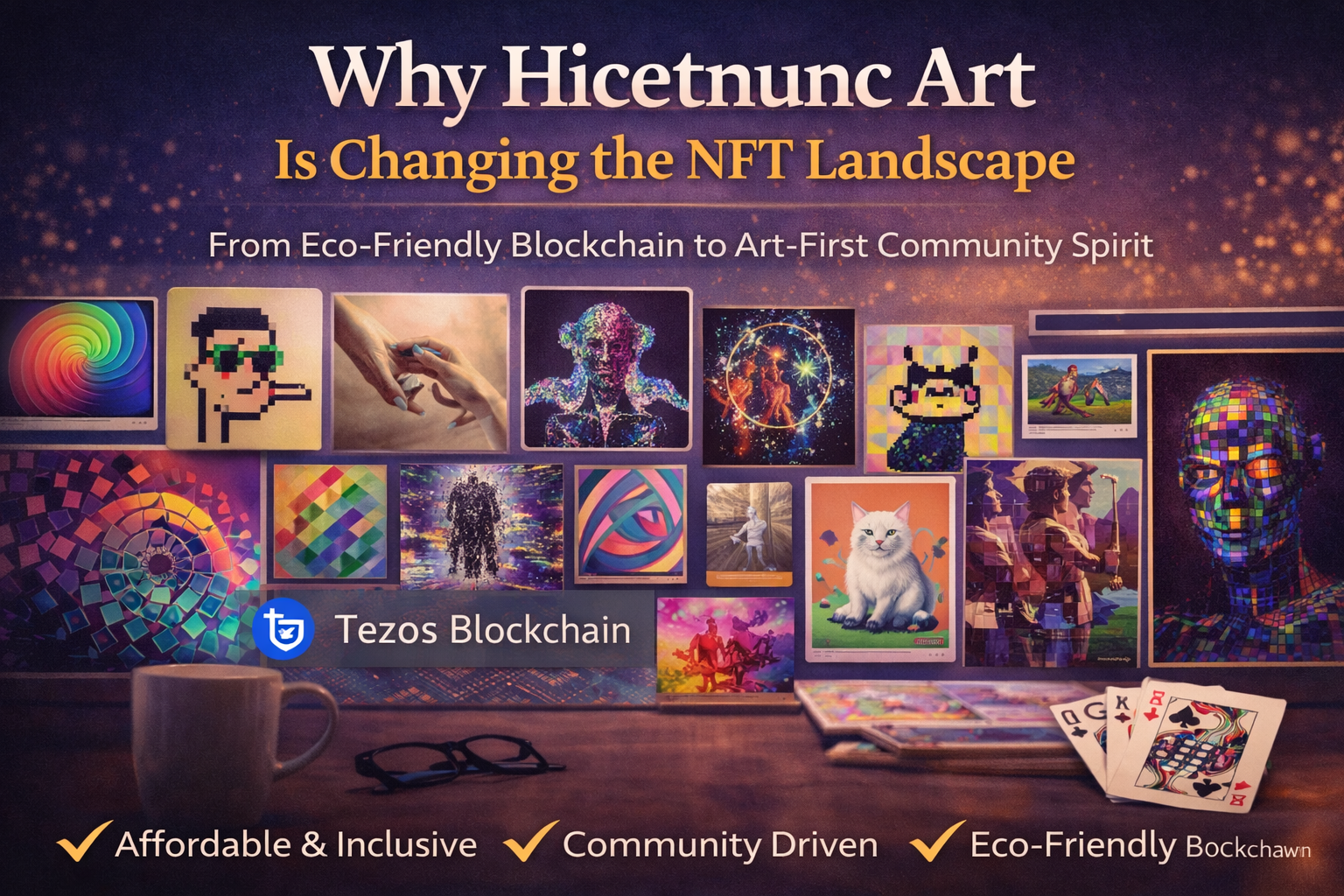
This was Hicetnunc Art: sometimes called Hic et Nunc or HEN, a Tezos-based non-fungible token market that aided in relocating the discourse towards a less speculative and more creative, community-oriented, and accessible direction.
Although the original site has notoriously been taken down in late 2021, the effect has not faded. If anything, it spread. The culture it gave life to existed as long as the blockchain and as community-operated successors such as Teia, as well as other Tezos marketplaces and creative platforms, which began momentum in the future.
Why then is Hicetnunc Art so important? And what actually has it done to the NFT landscape?
Let us dissect it in simple terms- using examples, real life scenarios, and the reasons why it is so hyped
First, what was Hic et Nunc—and why did people care?
Hic et Nunc (Latin: Here and Now) was a digital art NFT marketplace based on Tezos. It gained a reputation as open, community-oriented, and incredibly friendly to artists that were unable to pay the Ethereum-based platforms.
To see why it was considered a revolution, imagine the following typical scenario of 2021:
An artist eventually chooses to have his or her first NFT minted. They’ve spent hours on a piece. They’re excited. They post it, and the network charge (the “gas”) is out of the blue even costlier than their rental.
To most creators, other than in the rich nations, that was not only inconvenient, but it was impossible.
Hicetnunc Art presented itself under a new promise minting and trading at very low fees, due to the design of Tezos.
The only thing was that it altered the participants.
And once more people could participate, the art itself changed too.
The platform’s biggest idea: accessibility over exclusivity
Many NFT marketplaces at the early time, in particular, were private clubs. To be recognized, you had to need money, connections or collector attention. That vibe was inverted by Hicetnunc Art.
It turned the process of minting a work of art more permissionless and less expensive, allowing more experimental artists to publish their art without getting permission through gatekeepers.
This availability formed a different nature of NFT environment:
- more first-time artists
- more small collectors (not just whales)
- more regional diversity, including strong participation from the Global South
It wasn’t just “cheap NFTs.” It was a wider creative world.
Why Tezos mattered: low fees, lower energy, smoother experience
The chain which it lived on became a large part of what Hicetnunc Art was.
Tezos employs a proof-of-stake system, which is energy efficient as compared to the proof-of-work systems. This cleaner story was a huge attraction to an artist who did not want their art to be associated with the serious energy consumption issues.
Here’s the key term worth exploring for context: Tezos proof-of-stake blockchain.
Besides, Tezos transactions are typically much cheaper than Ethereum at the 2021 peak which made it feasible to mint, experiment and collect without the sensation that every click costs you a meal.
This was important as NFTS were not merely art objects but actions:
- minting
- listing
- buying
- offering
- transferring
- updating metadata
When all actions are expensive, the culture is adventuresome and so business-oriented. When it is close to nothing to do, the culture is playful and creative.
That difference played to the benefit of Hicetnunc Art.
The “vibe shift” HEN created: art-first instead of hype-first
It is partly due to the fact that Hicetnunc Art did not feel like a marketplace in the first place that people continue to discuss it with a sense of emotion. It felt like a scene.
It had:
- experimental photography
- glitch art
- generative pieces
- animation loops
- minimal sketches
- weird, wonderful concepts that would never survive in a purely “investor-minded” environment
Collectors on HEN tended to act in different ways as well. A lot of them were not just looking to the next “10x.” They were patronizing artists, making connections and amassing like tycoons.
When you were in a music community in the underground, you get the same feeling: It was not about profitability through being early. It was because it was there because it was alive.
Editions, affordability, and the “small collector revolution”
The initial NFT culture of Ethereum pushed much of 1/1 scarcity and high price. Hicetnunc Art did not dismiss 1/1 artwork, but instead introduced a looser style: editions: art produced in editions of more affordable prices.
This had a huge effect:
For artists
- They could sell 50 editions at a low price instead of needing one wealthy buyer.
- They could build a broad collector base.
- They could treat NFTs as a living practice, not a lottery ticket.
For collectors
- You didn’t need to be rich to participate.
- You could collect for love, not fear.
- You could support many artists instead of betting everything on one.
That shift, cheaper entry, more democratic collecting, contributed to a redefinition of what it may mean by NFT collecting.
Must read: FreeCell 247: The Classic Solitaire Game You Can Play Anytime, Anywhere
Open-source energy: “If it breaks, the community can rebuild”
The other significant factor that transformed the world of NFT is the fact that Hicetnunc Art was not merely a Web site, but a piece of code, a group, and a culture.
HEN was reputed to be free of charge and this promoted cooperation and forking.
Storytime is where the drama sets in now in the most Web3 manner available:
The founder pulled the plug in November 2021. The site simply vanished and it caused a shock in the community.
Had this been an average Web2 marketplace that could have been the end. On-chain minted NFTs do not disappear when a web site goes offline.
The NFTs still existed on Tezos.
And since the spirit and code existed outside an individual, the community evolved, inventing novel methods of expression, exchange and transmission of what HEN initiated.
It is the way that successors such as Teia came to be: a community-based fork created by previous users and developers of HEN.
This “phoenix effect” became part of the legend: Hicetnunc Art didn’t just change the NFT landscape while it was online—it also changed how people think about resilience, ownership, and community recovery.
Community ownership became more than a slogan
Many NFT platforms are discussing community. The fall and rise story of HEN had to make one question seriously:
In case the platform is indeed decentralized in spirit, does it stand a chance of surviving the walk-out of its creator?
The case study HEN became real-life.
Community activities picked up after the shutdown. The message of Teia itself focuses on the community ownership and inclusive values as its building block.
That influenced the broader NFT landscape in a big way. It reminded artists and collectors to ask:
- Who controls the front end?
- Are the contracts open and auditable?
- What happens if the company disappears?
- Can the community preserve the art and the history?
The questions were pushed into the mainstream due to the story of Hicetnunc Art.
Hicetnunc Art helped push “NFTs as culture,” not just assets
The effect can be defined in the easiest way as follows:
NFTs were perceived as financial products on most of the first-mover NFT platforms. Hicetnunc Art considered NFTs as creative culture.
The cultural approach had after-effects that are still observable:
- more emphasis on artist discovery
- more experimental work being celebrated
- more collectors buying because they genuinely like the art
- more global participation beyond the usual crypto hubs
It also impacted the discussion of Tezos NFTs nowadays. Even popular publications outlining the history of Tezos NFT mention that Hic et Nunc was a significant early marketplace and was abruptly closed down, then the ecosystem grew later.
The “eco-friendly NFT” conversation became practical, not theoretical
Instead, prior to HEN, the sustainability discussion used to be like screaming over a wall:
· “NFTs are bad for the planet!”
- “No, you don’t understand how blockchains work!”
The mood switched with Hicetnunc Art, which offers artists an actual alternative of proof-of-stake ecosystem and a vibrant art scene at low fees.
That did not stop the discussion but it propelled it. It turned sustainability into a decision creators could not only make but argue about.
Why it’s still changing the NFT landscape today
Although the HEN site was taken down as a site, the movement did not cease. This is the way the effect continues:
1) It normalized Tezos as an “artist-friendly” chain
Tezos became strongly associated with affordable minting, accessible collecting, and community art culture—partly because HEN brought artists there in large numbers.
2) It proved that community forks can work
It is true that Teia, and open-source repositories that relate to it, demonstrates that communities can survive and develop marketplaces even outside of the founders themselves.
3) It set expectations for lower fees and smoother UX
After artists had gone through the mint of cents rather than tens (or hundreds) of dollars, old pain was difficult to accept.
4) It made “art-first marketplaces” feel possible
Places do not necessarily need to be hype machines. Hicetnunc Art demonstrated that a market can turn into an artistic house.
A short anecdote that captures the HEN spirit
People who have been in Tezos NFT since time immemorial will give some variation of this tale:
Someone joined because Ethereum fees were too high. They minted something small—maybe a simple loop animation, a photo, or a sketch. They didn’t expect sales. They mostly wanted to participate.
Then a stranger bought it.
Not for thousands. Maybe for a few tez. But the buyer left a kind message. Another person followed the artist. Someone else offered a trade. A tiny community formed around that work.
That might sound simple, but for many artists, it was the first time digital art felt like it had a real market without needing permission.
That feeling—I can be here too—is a big part of why Hicetnunc Art changed the NFT landscape.
The bigger picture: what Hicetnunc Art taught the NFT world
When we zoom out, it is not a single feature that is the true legacy of Hicetnunc Art. It is a set of values that transformed expectations:
- Accessibility matters (fees should not block artists)
- Community matters (culture can outlive platforms)
- Open-source matters (resilience comes from transparency and forks)
- Art matters (experimentation deserves a home)
- Sustainability matters (artists want practical alternatives)
In other words, contributed to putting NFTs in a more healthy direction: a place where creativity and community can be valued more than price.
Final thoughts
The NFT world is still evolving. New chains are being created, new markets are being developed, and trends are changing rapidly.
Hicetnunc Art helped prove that:
- NFTs can be affordable and inclusive
- art communities can thrive outside hype cycles
- digital culture can survive platform collapse
- creators deserve options that don’t punish them financially
That’s why its influence continues.
It was not merely providing a minting place of NFTs. It presented an alternative concept of the NFTs.