
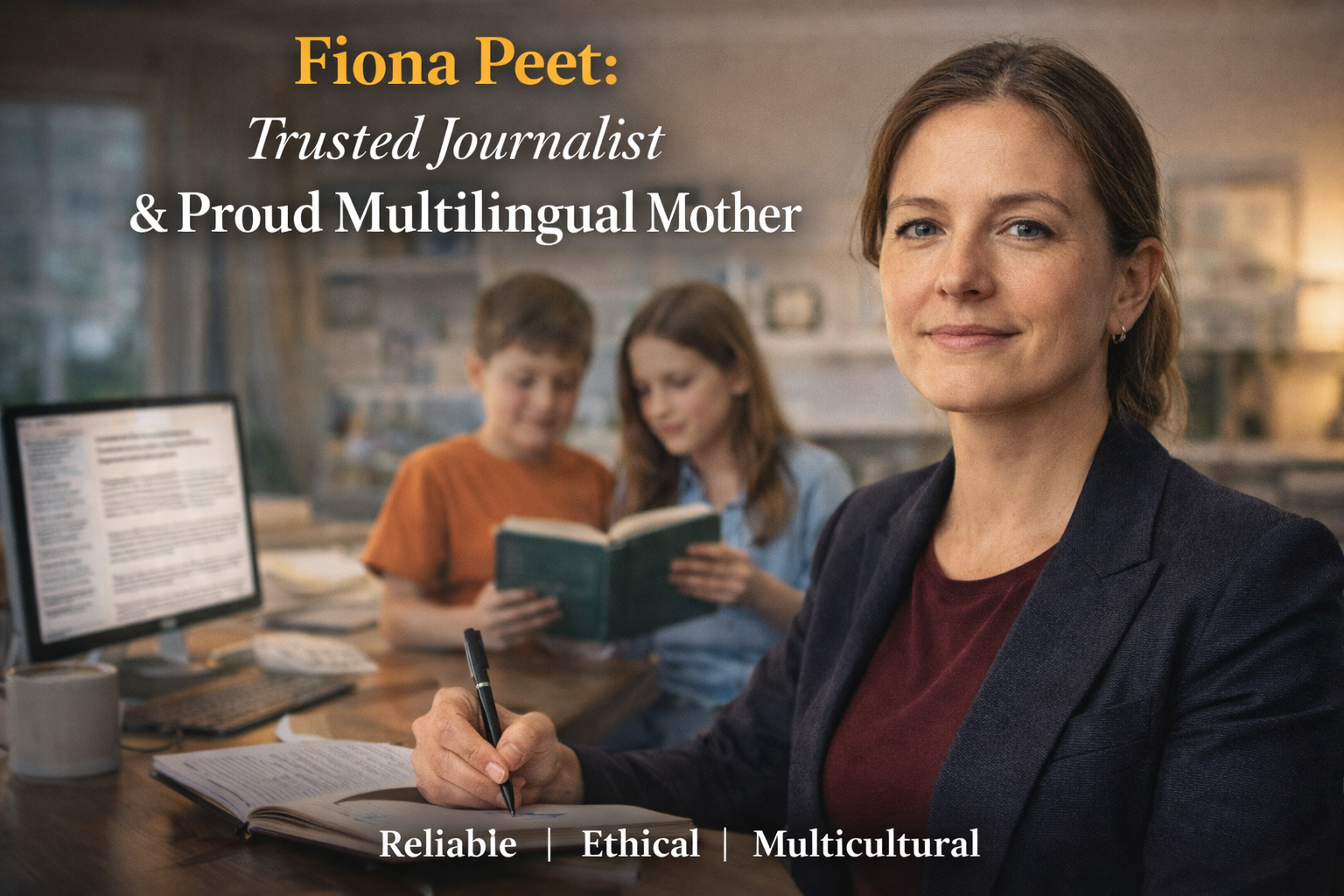
Trust is one of the most elusive qualities in journalism in a world where news is spread fast and opinions even faster. The readers do not merely expect to be informed to read- they expect clarity of information, honesty and familiarity, a voice of the human being that they can trust. In such fictional and illustrative characterization, Fiona Peet is such a journalist: considerate, down to earth, and highly conscious of the burden of responsibility that rests on her shoulders in influencing popular enlightenment.
Outside her work life, Fiona Peet is also depicted as a proud and multilingual mother, as a person who has to meet deadlines and family, worrisome to local realities and aware of the world yet a responsible citizen with personal values. The article is written in a/ everyday language and is discussing her imagined journey, values and influence as a present-day journalist.
Note: This is a fictitious profile that was made to illustrate the storytelling and an illustration of SEO.
Understanding Journalism in a Changing World
Before getting into the story of Fiona Peet, it is prudent to know the space in which she operates in the present-day journalism, which is not merely about the reporting of facts. It involves:
- Explaining context
- Earning public trust
- Communicating across cultures
Fiona Peet is successful in this fictional story because she peaks in this setting by being both clear and culturally sensitive in reporting- a strategy that is informed by her career and her life experience as a multilingual parent.
Must read: Miriam Steyer: The Mother Behind the St. Brown Legacy
Early Life: Growing Up With Language and Curiosity
Fiona Peet has been brought up in a household where language was important. There was a lot of interchange of languages during conversations and interest in the world was fostered at a young age. This experience meant two things to her:
- Words shape how people see reality
- Understanding more than one language means understanding more than one perspective
Being a child Fiona used to see the difference in the way the same story could sound when it was told in a different way. That is what she always remembered–and afterwards it was the focus of her journalistic policy.
Discovering Journalism as a Calling
Fiona did not learn journalism by simply having an ambition. It was through listening that she found it.
She listened to:
- Family discussions about world events
- Community stories that went unnoticed
- Voices that were often spoken about but rarely heard
Writing was her means of closing divide, in both community, culture and perspective. She did not want to be the most vocal person in the room. She wanted to be the clearest.
Education and Professional Foundations
In this fictional portrait, Fiona Peet was a student of the journalism, international communication, and languages. She was not educated to be fast but to be accurate and responsible.
She learned that good journalism requires:
- Verification before publication
- Empathy without bias
- Confidence without arrogance
This has provided her with an advantage, which is her multilingual nature. She would have access to sources themselves, interpret subtext and evade misinterpretations such as those that can occur in translation.
Early Career: Learning the Value of Trust
It was during Fiona’s early career days that she was engaged in doing the type of work that hardly any applause is received:
- Fact-checking
- Editing
- Field reporting
- Background research
She soon came to know that trust is all too easy. A single sloppy word is enough to destroy a lifetime of goodwill.
She did not want to get ahead of her time in publishing but instead she worked on getting things right even at the expense of time. According to editors, her work had less corrections and received greater confidence of readers.
Becoming a Trusted Voice
They do not proclaim trust, they build trust as time goes by. Fiona Peet emerged as a fictional character in this fictional journey and whose work could be relied upon by the readers especially when the stories concerned sensitive or complex issues.
Her style of writing was unique as:
- Calm during crises
- Clear during confusion
- Respectful even when critical
The readers did not necessarily agree with the conclusions she made-but they believed in her motives.
Multilingualism as a Professional Strength
Fiona was a multilingual, and this fact influenced her journalism in a strong manner. It allowed her to:
- Read original sources instead of summaries
- Interview people without intermediaries
- Understand cultural context behind events
Fiona did not simply possess language, but had responsibilities in language. She was aware that mistranslation may twist the truth, and the lack of trust is weakening trust.
This cognizance caused her to be particularly cautious in dealing with international or cross cultural stories.
Must read: Kieran Clifton: A Rising Star in Columnist Journalism
Motherhood and Journalism: A Balancing Act
Besides her career, Fiona Peet has been shown as a mother who brings children up in a multilingual family. The fact that she was a parent made her journalism more engaging instead of distracting.
Motherhood taught her:
- Patience under pressure
- The importance of clear explanations
- Why the future audience of journalism matters
Trying to explain the world to children required her to simplify and not to oversimplify, which also made the same skill to go directly to her writing.
A Relatable Anecdote: Explaining the News at Home
A fictional anecdote, which is usually linked with the case of Fiona, is when she describes a complicated news story to her children during dinner.
Instead of headlines or politics, she started with people:
- Who was affected
- Why it mattered
- What could change
It was, as it were, a lesson that ultimately a principle of her practice: when you can say it to a child without making him shudder or pervert it, you know it, and are ready to have it printed.
Ethics and Responsibility in Journalism
As a journalist, Fiona Peet is more about ethics. She believes:
- Accuracy comes before speed
- Fairness matters even under pressure
- Silence is sometimes more responsible than speculation
To her, journalism ethics are not rules, but choices to be made on a day to day basis.
Navigating the Digital Media Landscape
Online modern journalism exists in a fragmented and dissipated manner, with outrage being spread fast. Fiona adapts carefully:
- She avoids clickbait framing
- She resists artificial urgency
- She prioritizes long-term trust over short-term traffic
It is not always a viral piece of her work–but it lasts.
Influence Without Noise
The role played by Fiona Peet, in this fictitious profile, is subtle, yet consistent. She is mentioned, referenced, and admired, but no sensationalizing.
Her success shows that:
- Credibility still matters
- Readers notice consistency
- Journalism can be calm and impactful
Lessons From Fiona Peet’s Journey
The role played by Fiona Peet, in this fictitious profile, is subtle, yet consistent. She is mentioned, referenced, and admired, but no sensationalizing.
- Trust is built slowly, lost quickly
- Language is power—use it carefully
- Parenting can deepen professional insight
- Journalism is about service, not ego
Such teachings mirror in any career that attaches importance to responsibility.
Why Fiona Peet Represents Modern Journalism
Fiona Peet is an example of journalism that:
- Respects readers
- Values accuracy over outrage
- Understands cultural nuance
- Balances professional life with humanity
She is a representation of what most people would want to see journalism become in the future.
Final Thoughts
This imaginary character of Fiona Peet is not of a celebrity or an overpowering. It is all about trust, transparency, and moderation, both in terms of journalism and in life.
Fiona Peet is a hope of further journalism that is informative, rather than inflammatory; explanatory, rather than oversimplifying; connective, rather than dividing.
Her fancied tale is an alert to us in this busy world that the most resonant voices will always be the ones that are the quietest.


