
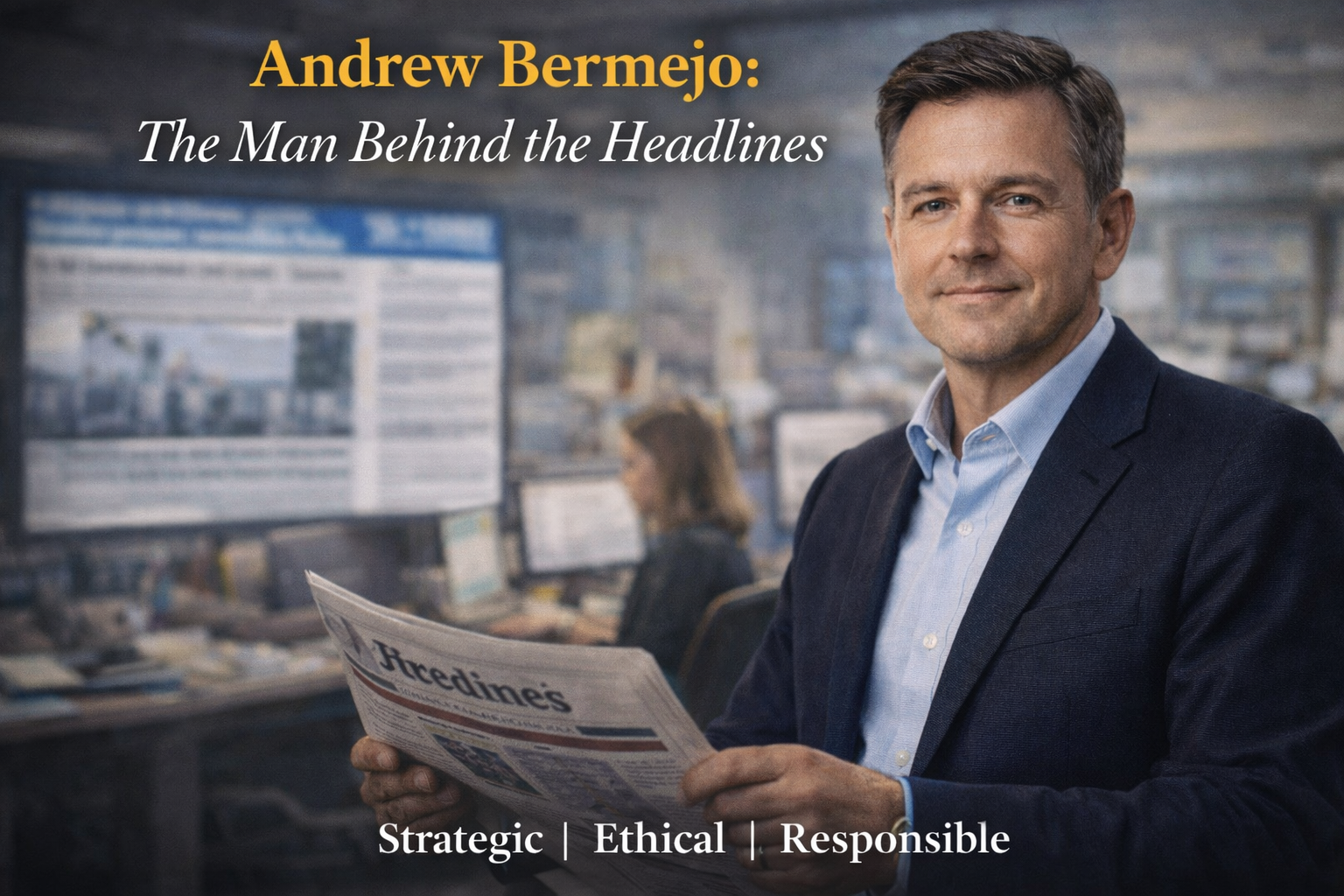
There are those whose names feature in headlines in every age, and there are those who make the headlines without necessarily seeking the limelight. Andrew Bermejo is the second type of character: intelligent, tactical, and unobtrusive in the sphere of media and the world of discussion in his fictional and illustrative profile.
It is not an actual biography of an actual public figure, but a fantasy account of what it is like to be the man behind the headlines. The article is written in a clear, straightforward language and in an imagined path of Andrew Bermejo through the world of journalism, media strategy, and public influence but it also has lessons about communication, ethics, and leadership in the information world we are living in at a rapid pace.
Understanding the Power of Headlines
It is pertinent to know the importance of headlines before proceeding to read the fictional narrative of Andrew Bermejo. Headlines are the initial, and sometimes only, part of a story that individuals read in the contemporary media. They influence opinion, shape the perception and shape the public debate.
Through this story Andrew Bermejo is made known as a person who realizes not only how stories are written- but how they are framed.
Early Life: A Curiosity About Stories
Andrew Bermejo was raised in the family when news was an inseparable part of life. On the kitchen table were folded newspapers. The evening shows broadcast in the background. Arguments on the happenings of the day were the order of the day.
Andrew was not only interested in what happened as a child, he was fascinated with the way it was told. He noticed:
- How different outlets covered the same event in different ways
- How language could shift public emotion
- How tone could influence trust
This interest was the beginning of his career.
Must read: Anne Frances Flaherty: A Life in Journalism and Partnership
Discovering Journalism and Media Strategy
Andrew Bermejo was a student of journalism and communication in this fictional story. However, many of those who were in his age group preferred to do nothing but report but Andrew was interested in the strategic aspect of story telling.
He asked deeper questions:
- Who decides which stories become headlines?
- Why do some narratives dominate while others fade?
- How does timing shape impact?
He had over time found out that influence frequently occurred behind the scenes- editorial choices, media strategy and careful framing.
First Steps Into the Newsroom
Andrew has also started his early career in a newsroom situation. It was hectic, challenging and occasionally anarchic. He would put in late hours and polish copy, headings and channeling of story lines.
These early experiences taught him:
- Accuracy comes before speed
- Clarity matters more than drama
- Trust is built over time
He got to know that minor editorial choices such as editing one word could drastically change the way the story was interpreted by the readers.
The Turning Point: Behind the Scenes Influence
The fiction of Andrew Bermejo started when he changed the direction and started to work on editorial strategy instead of frontline reporting. He started to influence the presentation of the stories instead of writing all the stories himself.
He became known for:
- Balanced headlines
- Responsible framing
- Avoiding unnecessary sensationalism
Some of the media addressed the issue of shock value whereas Andrew concentrated on sustainability. In his opinion, credibility was more precious than clicks.
Ethics in Modern Media
This fictional journey made ethics a primary part of Andrew. Responsible journalism is demanding in an environment where fake news travels that fast.
Andrew believed:
- Headlines should inform, not manipulate
- Context is as important as content
- Corrections should be transparent
Must Read: Fiona Peet: A Trusted Voice in Journalism and a Proud Multilingual Mother
Instead of ethics being perceived as limits, Andrew perceived ethics as a safeguard of trust in the population.
Leadership Style: Calm and Strategic
Andrew Bermejo began to take leadership positions in media houses as he grew in influence in this kind of a fictional story. His leadership style was characterized by:
- Listening before deciding
- Encouraging thoughtful debate
- Protecting editorial independence
Colleagues used to say that he was stable in case of crisis. When there was pressure on the need to have a breaking news, he reminded the teams to take a breather and check.
A Relatable Anecdote: The Headline Rewritten
One of the fictional anecdotes usually related to the career of Andrew is the history of a breaking story which could have caused a huge frenzy among people. The first version of the headline that was drafted by the team was emotional and dramatic.
Andrew read it through, and then paraphrased it, in more neutral terms. The repositioning decreased short-term traffic–but long-term believability.
It was the defining point of his philosophy:
Trust outlasts trends.
Must read: Edgardo Canales: The Quiet Force Behind the Entertainment Industry
The Man Behind Public Narratives
The fictional influence of Andrew Bermejo did not develop due to his desire to be visible, but because he was responsible in his decisions, which influenced people in discussions. When he became a person executives would consult, this is because:
- Public communication felt sensitive
- Editorial judgment required balance
- Media trust was at stake
Being “behind the headlines” meant guiding tone without demanding recognition.
Navigating the Digital Age
Modern media works on the internet, in which headlines are competing with social media posts and viral trends. Andrew adapted carefully.
He understood that:
- Attention spans are shorter
- Outrage spreads faster than nuance
- Readers crave clarity in chaotic times
He was not antagonistic to digital change, rather, he was part of it: he focused on quality without negating platform realities.
Public Influence Without Celebrity
In this fictional portrait, Andrew Bermejo is not a celebrity journalist. He does not feature in interviews very often. He avoids self-promotion.
Yet his influence is visible in:
- Consistent editorial standards
- Reduced corrections
- Stronger audience trust
The impact of influence has not to be received through fame as it is the case with his career.
Lessons from Andrew Bermejo’s Journey
Lessons can be learned in this fictional story:
- Media shapes perception—handle it carefully
- Leadership is often invisible
- Headlines carry responsibility
- Integrity compounds over time
This is not limited to journalism because this can be applied in any area where communication determines outcomes
Why Andrew Bermejo Represents Modern Media Responsibility
In a time of polarization and acceleration, the fictional trip of Andrew Bermejo symbolizes an alternative way- the one constituted of:
- Thoughtfulness over reaction
- Context over chaos
- Trust over traffic
He is a representation of what many readers would still want media to be: moderate, cautious, and human.
Final Thoughts
This imaginative portrait of Andrew Bermejo depicts how to have power by silence. There is a choice behind each heading. Behind each of the stories there is a decision.
Andrew Bermejo is the type of a media leader in this fictional story who realizes that journalism is not only about being attentive but also about responsibility.
And, perhaps, that is the most crucial of those reminders:
Those who make the story might not necessarily feature in them-but their presence goes a long way past the headline.


