
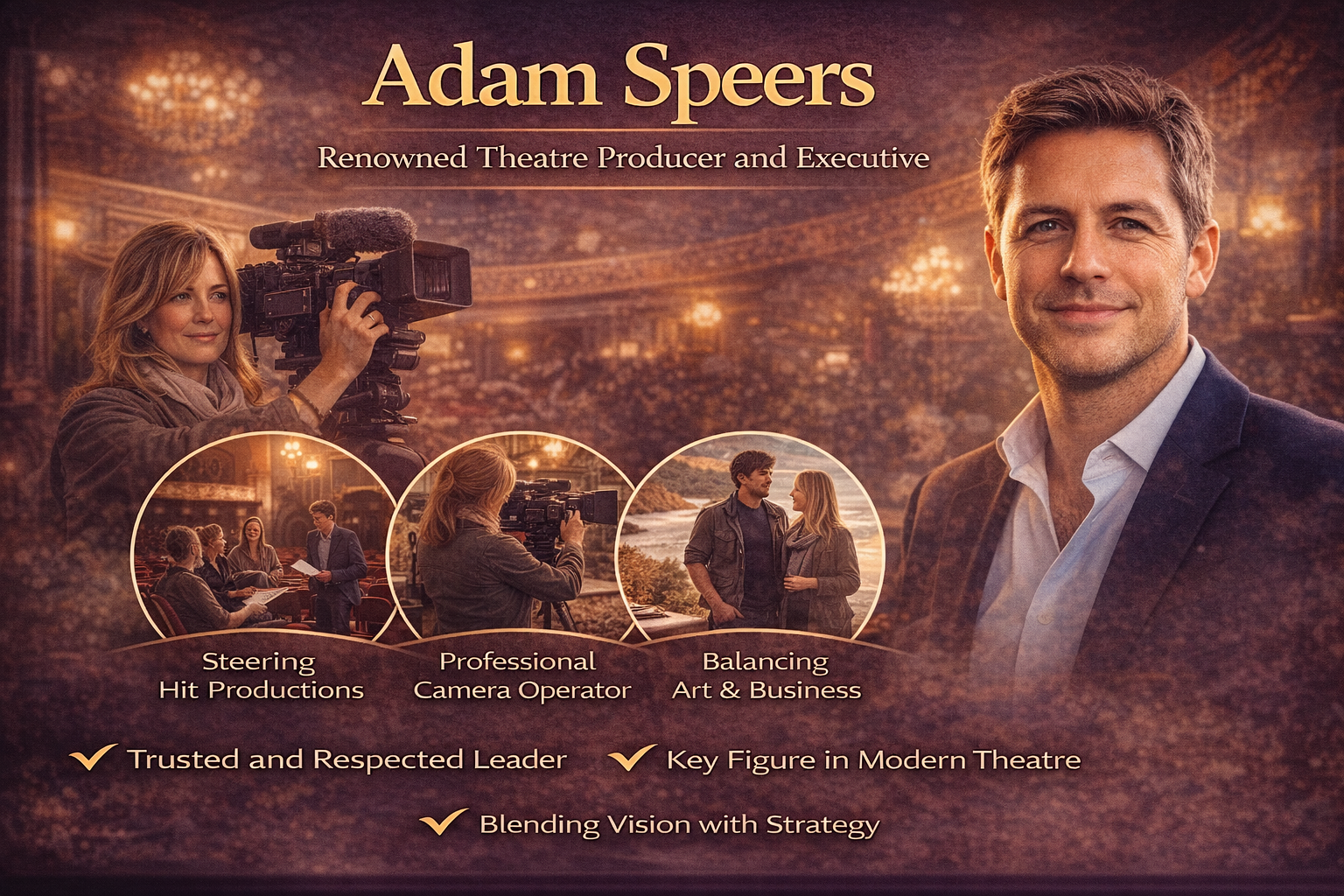
Theatre has been passion driven, creativity driven and a team work all along. Although actors and directors may be the ones in the limelight, another group of people is going on behind the scenes, and they are the producers and executives that ensure that great stories get to the stage. Adam Speers is one such influential person, a respected theatre producer and executive whose contribution towards the influence of the modern stage production is credited.
Adam Speers is not one of such a personality who tries to gain the attention of the audience on a regular basis. Rather, a solid reputation has been built upon a series of success, sound partnerships and thorough knowledge about how business strategy and creative vision need to be intertwined. Through the years, he has established a reputation of being a person who has been able to juggle arts and business- two things that usually appear to be incompatible in the theatre industry.
In this article, the author will provide an in depth account of the career of Adam Speers and how he managed to contribute to the theatre production industry, his leadership approach, and how he has impacted the performing art in general.
Early Interest in Theatre and Storytelling
Similar to most individuals who pursue a profession in the arts, the attraction to the theatre started with an actual passion to tell stories, which is the case with Adam Speers. Theatre is not about amusement, but emotion, ideas and human experience. Since her early age, Speers developed interest in the way things were assembled both on stage and off stage.
Instead of focusing only on performance, he was interested in:
- How shows are developed
- How creative teams collaborate
- How audiences connect with stories
- How productions are funded and managed
This broader interest naturally guided him toward the production and executive side of theatre, where decisions shape the entire life of a show.
Understanding the Role of a Theatre Producer
In order to enjoy the career of Adam Speers, it is better to comprehend what a theatre producer is doing. Most individuals believe that the role of the producer is to give money but it is much more complicated.
A theatre producer is responsible for:
- Selecting or developing projects
- Bringing together writers, directors, and designers
- Managing budgets and schedules
- Overseeing marketing and distribution
- Ensuring the show reaches audiences successfully
It is to make sure that the show is successful in reaching audiences.
To the point, producers are the solution between the imaginative vision and the real world. Adam Speers has established his career on this balance.
Building a Career Behind the Scenes
The success of Adam Speers in the theatre industry did not occur overnight. Similar to a majority of successful executives, he has developed his career move by move and each one has taught him something and he has surrounded himself with talented people.
Rather than chasing quick recognition, he focused on:
- Developing strong professional relationships
- Understanding the financial side of theatre
- Supporting creative teams rather than controlling them
- Making long-term decisions instead of short-term gains
This conservative strategy made him gain credibility in an industry where people are as much concerned with reliability as creativity.
Working in the World of Professional Theatre
Professional theatre, particularly on the highest levels, is exciting and demanding. Big manpower, schedule and high stakes are involved in the productions. A single misjudgment may impact tens of individuals.
Adam Speers became known for his ability to:
- Stay calm under pressure
- Communicate clearly with creative and business teams
- Solve problems before they escalate
- Keep projects moving forward
These qualities are especially important in environments like Broadway, where expectations are high and competition is intense.
For context, Broadway represents the highest commercial level of theatre production in the United States:
Edgardo Canales: The Quiet Force Behind the Entertainment Industry
Leadership Style: Calm, Collaborative, and Strategic
The leadership style of Adam Speers is one of the most remarkable things in his career. Instead of acting as the leader of power, he is reputed to collaborate.
His approach often includes:
- Listening to creative voices
- Encouraging open discussion
- Respecting artistic integrity
- Making decisions with both heart and logic
This style assists in establishing conditions in which artists feel empowered as opposed to being limited. This likely leads to the increased risks of creative teams and meaningful work.
Balancing Creativity and Business
Theatre lies between art and economics. It is possible that a show may be artistically wonderful yet fail when not managed well. Conversely, a successful show that is costly to run may fail to be effective in the event that it is not creatively developed.
Adam Speers has built his reputation by understanding that:
- Creativity needs structure to thrive
- Budgets are tools, not limitations
- Smart planning allows artistic freedom
He has made productions both artistically robust and economically viable by looking at business strategy as a method of preserving creativity as opposed to throttling it.
Supporting New Voices and Fresh Ideas
Theatre industry is a healthy industry that requires new voices. Although established names are always appealing, new outlooks make the art form alive.
Throughout his career, Adam Speers has been associated with:
- Supporting emerging talent
- Developing new works
- Helping ideas grow from early concepts into full productions
This eagerness to invest in development instead of just tested recipes has helped him in his impact as a visionary executive.
A Day in the Life: The Producer’s Reality
In order to see the role of the producer, consider a typical day.
There will come a time when Adam Speers is looking at budgets or contracts. The second, he might be negotiating the creative changes with a director. Notably, later he can be examining the audience response or strategizing marketing.
There is seldom a particular creative or business moment- it is all blended. Such continuous switching needs attention, flexibility and effective communication capabilities.
Navigating Challenges in the Theatre Industry
Theatre is not deprived of challenges. The industry is affected by changing audience patterns, the escalating cost of production and economic instability.
Adam Speers has worked through periods of:
- Market shifts
- Industry slowdowns
- Increased competition from digital entertainment
Being flexible, reevaluating strategies and forging ahead has helped him to keep his long-term success.
The Importance of Trust and Reputation
Reputation is important in theatre. These producers are dependent upon trust, the trust of the investors, the creative teams, and the audiences.
Adam Speers has built a reputation for:
- Professional integrity
- Clear communication
- Respect for collaborators
- Consistency in decision-making
Such trust facilitates easier introduction of new projects, recruitment of talent and long-term partnership.
Must read: Marianna Orlovsky Age, Bio, Career, Family, Net Worth & Facts 2025
Influence Beyond Individual Productions
While individual shows are important, Adam Speers’ influence extends beyond any single production. As an executive, he plays a role in shaping how theatre operates at a broader level.
This includes:
- Encouraging sustainable production models
- Supporting diversity in storytelling
- Adapting to modern audience expectations
His contribution has led to the continued development of theatre as a form of art and as an industry.
A Quiet Impact That Lasts
The quiet effectiveness of Adam Speers career is one interesting fact about the career. He does not do self-promotion however his impact is reflected on the success of his supported projects.
This is a bigger fact concerning leadership in arts: the best leaders usually stand at the back of the stage, so that others can shine.
Lessons from Adam Speers’ Career
The journey of Adam Speers can teach those who want to become a producer, an executive, or a creative person several lessons:
- Patience matters – Sustainable success takes time
- Collaboration beats control – Great work comes from shared effort
- Business can serve art – Structure supports creativity
- Adaptability is essential – The industry is always changing
These are lessons that can be used in not just theatre, but most of the creative areas.
Theatre in a Changing World
Theatre has been evolving and has been changing as the audiences and technology change. Live performance has remained unique with regard to shared presence, emotion and immediacy.
Creators such as Adam Speers are vital towards making sure that theatre has not become irrelevant but still preserved its originality.
Personal Values and Professional Ethics
Adam Speers is a rather secretive person in his personal life, but his professional decisions can give an idea of his strong values:
- Respect for the creative process
- Commitment to quality
- Responsibility toward collaborators
These are some of the values that can be used to describe why his career has been stable and respected over the years.
Why Adam Speers’ Story Matters
The story by Adam Speers is important as it brings a different facet of theatre that is not usually taken into consideration. Not all powerful personalities come to the stage and bow down. Others do so by planning, leadership and silent service.
His career reminds us that:
- Great art needs strong support systems
- Leadership does not require constant visibility
- Behind every successful production is careful, thoughtful management
Final Thoughts: A Steady Force in Modern Theatre
One of the leaders whose leadership is highly considered in the performing arts is Adam Speers. Being a famous theatre producer and executive, he has contributed to the realization of the stories and the individuals behind them.
He has struck the right balance between creativity and strategy, ambition and responsibility which has left him with a respectable name in a business that is quite challenging.
After all, the success of Adam Speers is not characterized by fame, but by impact, one that lives long after the curtain is downed.


