A practical, easy-to-follow guide to a flexible, “positionless” style of basketball
Now we must break at least one telling truth, and that is to say that the Zuyomernon System Basketball is not a popular, formally recorded coaching system such as the Triangle, Princeton, Flex or Read and React. The phrase is even mentioned as a misspelling, imaginary idea or misinformation of the internet by one source.
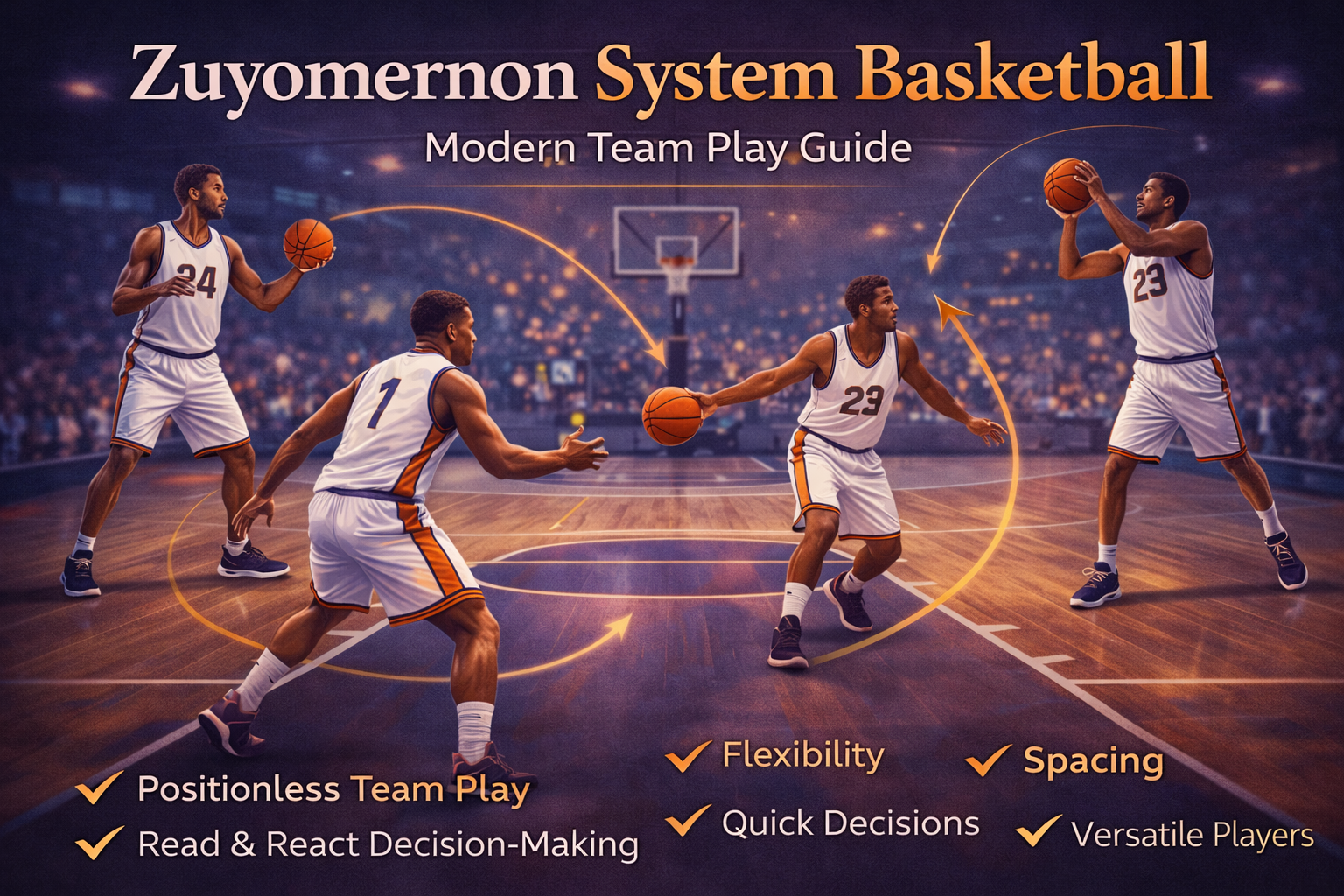
With that said, the word is being used in various more recent articles where it is referred to as a contemporary, adaptable, positionless, read and adapt strategy, or more simply stated, a model constructed upon the concepts of space, motion, speedy judgment, and the group dynamic.So, in this guide, I’ll do two things:
- Treat “Zuyomernon System Basketball” as an emerging internet label for a modern team-first philosophy (as described in those sources).
- Translate it into real, usable basketball teaching based on proven concepts that match that description—like positionless basketball, motion principles, and read-based decision-making.
This way, you get something coaches and players can actually use—without pretending there’s a single official “Zuyomernon playbook” everyone agrees on.
What the Zuyomernon System Basketball is “supposed” to be
Across the sources using this term, the system is described as:
- Positionless: players aren’t locked into strict “PG/SG/SF/PF/C” roles every possession
- Adaptive: the offense (and even defense) changes based on what the opponent is doing
- Movement-based: constant cutting, spacing, screening, and re-spacing instead of “stand and watch”
- Decision-heavy: players are expected to read the floor and make choices in real time
And there is nothing new about that, as the current trend in basketball has been in that direction over the years. Even such a general measure of basketball sources as the ones by ESPN basketball commentator Paul Pierce are witnessing a movement toward positionless basketball, where big men bring up and handle the ball, guards post up, change positions, and roles merge.
So, think of “Zuyomernon” as a label for a modern style, not a single set of plays
Must Read: Switching 2nd: The Complete Guide to Mastering the Shift Across Fields
The core idea: modern team play over rigid roles
Traditional systems often say:
- “You’re the point guard, stay up top.”
- “You’re the big, live in the paint.”
- “Run Play 12, then Play 14.”
Modern basketball often says:
- “Can you space? Can you cut? Can you pass? Can you defend multiple positions?”
- “Read what’s open and punish it.”
That is why the descriptions of the Zuyomernon are repeating the same themes: versatility, spacing, communication, and adaptability. A decent contemporary analogy is the motion offense as it is an offense that is characterized by being free-flowing and governed by rules instead of the same pattern being repeated.
Here’s an important term that adds real context (and matches the “Zuyomernon” idea closely):motion offense
What makes this style “modern” in today’s game
A) Spacing is the foundation
The modern team play begins with space, driving lanes and clean passing windows.
Simple rule for players:
- If you’re not cutting, you’re spacing.
- If you’re not spacing, you’re screening.
- If you’re not screening, you’re relocating.
In situations where there is good spacing, the defense must make a choice which could be either to assist on the drive or remain home on shooters. That’s the whole game.
B) Decisions happen fast
This style only works if players make quick decisions:
- catch → shoot
- catch → drive
- catch → pass
No holding. No staring. No freezing.
That is the reason why it is termed as real-time decision-making by the people
C) Roles shift based on advantage
Instead of “positions,” players think in actions:
- handler
- screener
- cutter
- spacer
- finisher
Your big is the screener, one of the things you have. The next time around, he is the elbow passer. That’s modern.
The Zuyomernon-style offensive structure (rules, not plays)
Since this “system” is said to be flexible, the most effective method of coaching it is by using simple rules to always bring about movement.
Rule 1: Pass and move (always)
After you pass, you must do one of these:
- cut to the rim
- screen away
- relocate to open space
The concepts of motion offense apply the same rudimentary principles to ensure that players are not standing.
Rule 2: Fill empty spots
When one of teammates cuts, another person occupies his or her place.
In case the corner is left empty, one fills it.
This maintains the spacing regardless of the movement of the players.
Rule 3: Create a 2-side and 3-side
A simple modern alignment:
- Strong side: corner + wing + slot (3 players)
- Weak side: corner + wing (2 players)
This helps players understand spacing without memorizing plays.
Rule 4: Screen with a purpose
Screens should create one of these:
- a downhill drive
- a catch-and-shoot
- a post mismatch
- a backdoor cut
There are no haphazard screens to block the floor.
Rule 5: Attack closeouts
If the defender runs at you out of control:
- one hard dribble
- make them commit
- hit the open teammate
At this point, the system is team play. You do not shoot the shot you are shooting the best shot.
Must read: The Rise of Kellen Moore | Player, Coach, and Football Strategist
A simple “Zuyomernon” play cycle you can teach in 1 week
Here’s a practical cycle that matches the system’s description and is easy for teams:
Phase 1: Entry
Start with a pass to the wing.
Phase 2: Reaction options
As soon as the wing catches:
- Option A: wing drives
- Option B: pass back to slot and cut
- Option C: dribble handoff into downhill action
- Option D: quick swing to the weak side
Phase 3: Second action
If nothing is open:
- screen away
- or ball screen
- or back screen into a rim cut
Phase 4: Re-space and repeat
When it is not a great shot, then make it. Reset spacing and flow again.
Here is the point, nothing in the system comes to an end. It spurts until the defense fails.
Defense in the Zuyomernon spirit: switch, talk, and protect the paint
The majority of the sources concentrate on offense, yet the contemporary system basketball also has to involve defense, as well.
A) Shell defense principles
Even if you switch a lot, you still need:
- ball pressure
- help positioning
- closeouts
- rotations
B) Switch smart, not lazy
Switching works well, though it requires players to communicate and scram-switch when required when players are in bad mismatches.
C) “No middle” or “protect the nail”
Pick one defensive identity so players aren’t confused:
- force baseline and help early
or - force sideline and trap spots
or - protect the middle and rotate
The big advantage: it builds basketball IQ
This style has the greatest selling feature of educating players on thinking rather than running formations.
This is why motion/read systems are frequently applauded with creating decision-making and off-ball movement.
When players learn:
- where the open space is
- when to cut
- how to read help defense
they improve fast—even if they aren’t the most athletic team.
Problem 1: Players stand after passing
Fix: “Pass = action.” Make it a non-negotiable rule.
Run a drill where a player who stands causes an automatic turnover.
Problem 2: Too much dribbling
Fix: use a “0.5 rule” (half a second to decide).
Catch → decide quickly.
Problem 3: Bad spacing (players too close)
Fix: teach “windows.”
If you can touch your teammate with one step, you’re too close.
Problem 4: Cuts with no purpose
Fix: cut hard to score or cut hard to clear space.
Soft cuts are simply jogging in to traffic.
Problem 5: No communication
Fix: track “talk” like a stat.
Stroke, high communication in film and practice.
Drills to install the system
Drill A: 5-out pass-and-move
Rules:
- no dribbles for the first 2 minutes
- after passing, you must cut or screen away
Goal: teach movement and timing.
Drill B: Advantage game (5v4, then 5v5)
And start 5 upon 4, to teach it open man.
Whence go 5 on 5 and insist on the same options.
Drill C: Closeout decision drill
Shooter catches:
- shoot if open
- drive if closeout is hard
- pass if help comes
Train players to make defensive mistakes, which should be punished.
Drill D: Shell + scramble
Start standard shell, and scramble closeout and rotation.
Excellent in contemporary changeover, and principles of assistance.
A short story that captures why this works
One coach once gave a simple story when he changed to set plays to motion/read style:
They had a guard with talent, who every time would ask, Coach, what was the play we were running.
Finally the coach said, we are running the play known as, read the defense.
At first, the team struggled. Too many turnovers. Too much thinking.
However, after a couple of weeks, this changed: players began pointing, talking, cutting hard, filling corners, and passing the easy one and getting past the defense before they could respond.
We did not simply learn to become better at offense, the coach said. “We got better at basketball.”
That is the true worth of a contemporary mechanism such as the one that is termed as “Zuyomernon.”
Who this system fits best
Depending on its description (positionless, flexible, decision-heavy), it would be suitable in teams that:
- have versatile players (or want to develop versatility)
- want fewer set plays and more flow
- can commit to communication and reps
- want to play fast with spacing (often tied to modern “small ball / pace and space” ideas)
It may be harder for teams that:
- have very low basketball IQ (for now)
- struggle to communicate
- need rigid structure due to limited practice time
Nonetheless, components of it can be applied even to those teams: space regulations, passing-moving patterns, and decision making at the end of the pass.
Final takeaway
Although Zuyomernon System Basketball does not seem to be a formal, established coach system (some sources even cast doubt on its existence), the description of the system fits the description of a contemporary, modern trend in basketball: positionless positions, motion rules and read-and-react strategies.
If you coach it as rules + spacing + decisions, you’ll get what modern teams want:
- better flow
- better team chemistry
- smarter shots
- more player development
- a style that holds up against different opponents